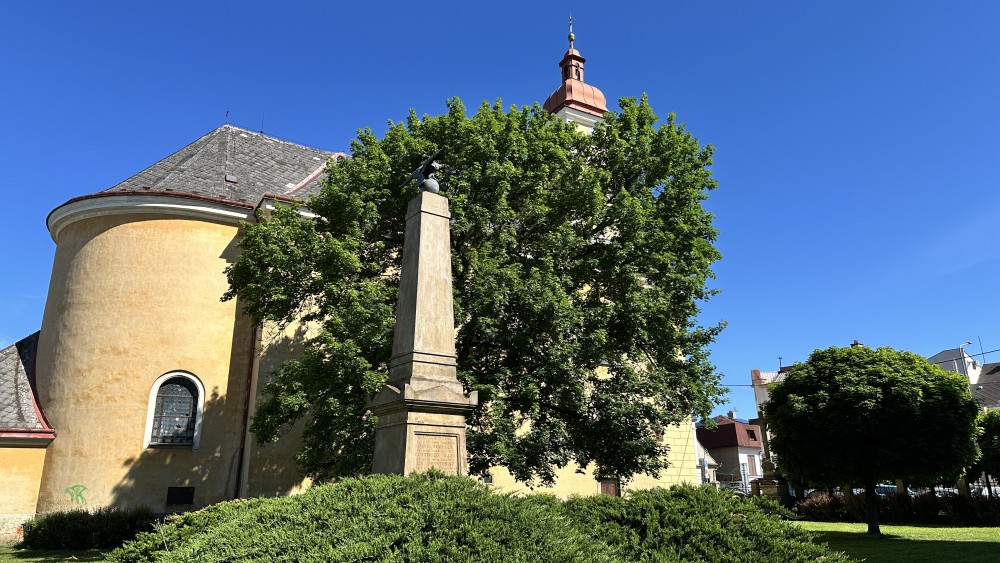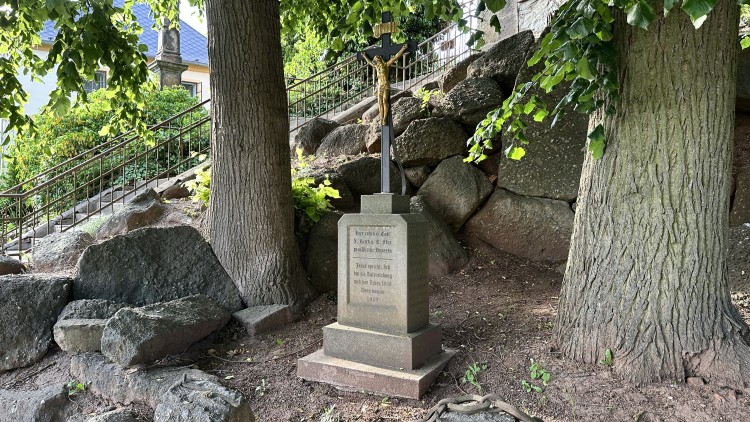
The Austro-Prussian War, which swept through the Czech lands in the summer of 1866, significantly affected many municipalities in Northern and Eastern Bohemia. A large number of monuments and standardized crosses, erected as a reaction to these events, can be found to this day. Among the forgotten and partially damaged ones is the memorial cross on a sandstone pedestal in the village of Rudoltice. Let us follow its turbulent history and the reason for its construction in the following lines. With a brief outline of the war situation at the time, we will find ourselves in the period after the Battle of Königgrätz and introduce several minor cavalry skirmishes on the Czech-Moravian border.
A part of the Austrian Northern Army was retreating towards the Olomouc fortress, offering only sporadic resistance to the advancing Prussian troops. The Austrian high command itself did not consider any energetic counter-action, and lower-ranking officers and soldiers in the marching columns, in their retreat agony, neglected even the most basic safety measures. Without proper cavalry protection, Svitavy was occupied by Prussian cavalry units from the direction of Litomyšl on July 7. About 700 horsemen under Lieutenant Colonel von Barnekow entered the streets of Svitavy, dispersed part of the Austrian train, and captured almost the entire company of the 4th Infantry Regiment Hoch und Deutschmeister. It was not until the Prussian riders and their captives left the town at night via the road towards Litomyšl that the route was again blocked by Saxon infantry battalions, which in the morning were replaced by companies of Wöber’s infantry brigade from the VIII Austrian Corps, along with riders of the 10th Uhlan Regiment. On the morning of July 8, the Prussian high command issued an order to advance vigorously after the retreating army due to a possible recovery of Austrian forces and to prevent any subsequent counter-attack. Units of the 2nd Prussian Army were ordered to advance on the Konice-Litovel line, and the 1st Army maintained its line of march directly towards Brno via Polička and Kunštát. These orders also resulted in an increased number of cavalry patrols from both sides and the potential for clashes with the adversary.
The first cavalry skirmish took place in the morning hours of July 8 near Opatov. Uhlans of Lieutenant Colonel von Barnekow from Major General Hartmann’s cavalry division attacked one squadron of the 6th Uhlan Regiment from the II Austrian Corps near the large Hvězda pond in the direction of the Třebovické sedlo. The Austrian Uhlans bravely repulsed this superior force, but under fire from Prussian cannons from the hillside, they were forced to retreat towards the village of Damníkov in the direction of Žichlínek and Lanškroun. They lost one man, two officers and one Uhlan were wounded, and four men were captured. This skirmish and the subsequent retreat were observed from Damníkov by an Austrian patrol from the 4th Hussar Regiment led by Rittmeister Morbitzer. The cavalry patrol had been sent in the early morning hours from Lanškroun towards Třebovice with the task of scouting the territory around Svitavy and Litomyšl. Let us quote the contemporary report sent at one o'clock in the afternoon from Damníkov to the division headquarters in Lanškroun by Rittmeister Morbitzer: “I respectfully report that Třebovice is occupied by the enemy. According to the testimony of farmers and the Imperial Uhlan patrol, a regiment of Prussian Uhlans has advanced along with artillery.” Just a quarter of an hour later, another report came from Rittmeister Morbitzer: “The enemy has occupied the hillside on both sides of the road to Damníkov. My patrols are in the village and are observing all activity. One squadron of Uhlans attacked the Prussian Uhlans, charged at them, and was then shelled by artillery. The entire 6th Imperial and Royal Uhlan Regiment has retreated to Žichlínek. We fired at two patrols. One division of enemy Uhlans with artillery is advancing on Damníkov.” Prussian Major General Hartmann reacted to this skirmish by strengthening his positions with the light cavalry brigade of Major General von Witzleben, which began moving from Semanín towards Třebovice. On the Austrian side, the headquarters in Lanškroun responded by sending a stronger cavalry detachment together with artillery to the area of Rudoltice, Luková, and Damníkov. Colonel Count Bellegarde, commander of a brigade from the 2nd Austrian Light Cavalry Division, set out from the Žichlínek area at the head of the 4th Hussar Regiment and half of a brigade battery to meet the advancing Prussians. A total of 630 riders with four cannons set out from the area south of Lanškroun. Both Austrian and Prussian units prepared for battle.
Upon entering Rudoltice, Colonel Count Bellegarde met the hussars of Rittmeister Morbitzer, who had withdrawn from the forward patrol near Damníkov. After reconnaissance of the terrain, the Austrian cannons took up a firing position completely hidden in a rye field east of Rudoltice between the road and the railway line to Lanškroun. The hussars took up positions on Knápek’s hill west of Rudoltice and simultaneously sent reconnaissance to the south towards Damníkov and to the north towards Ostrov. From the field of view of an observer at the Austrian artillery position, the road from Damníkov stretched through three gentle undulations of the terrain. The southwestern part of the village was visible from there, and the sharply rising hillside of Třebovské stěny formed the horizon. The church clock showed half-past three in the afternoon when Austrian reconnaissance patrols in the front line spotted strong Prussian cavalry units riding across Třebovské stěny towards the village of Damníkov. A few moments later, a heavy battle clash of the forward forces occurred. Two squadrons of the 2nd Prussian Regiment of Body Hussars deployed in the fields before the village and between the village buildings against one squadron of patrolling hussars from the 4th Regiment and pushed them back towards Rudoltice. The main cavalry forces, including artillery support, followed behind the Prussian reconnaissance.
At the same time, fighting was taking place on the northern side of Rudoltice. The Austrian patrol stationed on the hill Lískovec (Lískový kopec, 454 m a.s.l.) reported a clash between an Austrian patrol and the vanguard of Prussian hussars advancing from the direction of Ostrov. The tension was rising more and more. In the Austrians' field of view, Prussian cavalry units of the main forces suddenly emerged from the direction of Damníkov. As soon as they passed one undulation of the terrain, they were visible to the Austrians. But they immediately disappeared in the next valley. The riders looked tired, as they had set out from Litomyšl early in the morning and had spent the forenoon riding through waterlogged forest hills near Opatov. In the soft terrain, many horses lost their horseshoes and therefore trotted unsteadily. The Prussian riders reached the border of the cadastral territory of Damníkov and Rudoltice, where there were meadows, which in folk parlance are called “crazy swamps” because, on hot summer nights, light phenomena from easily flammable swamp gases occur there. The moment the Prussian riders were passing through these swampy meadows, the Austrian artillerymen opened precise fire at a distance of about 1000 paces, which had devastating effects. Within a second, the dead and wounded were lying on the meadow torn up by shells, and horses without riders were fleeing in all directions. The Austrian hussars, waiting in reserve on the hill, struck the confused squadrons of the 2nd Prussian Regiment of Body Hussars mercilessly and drove them back to Damníkov. There, they almost seized several enemy cannons. The Prussian units hastily retreated back across Třebovské stěny through the pass to Třebovice. The light cavalry brigade of Major General von Witzleben then retreated to the Hvězda pond near Opatov, where it set up camp.
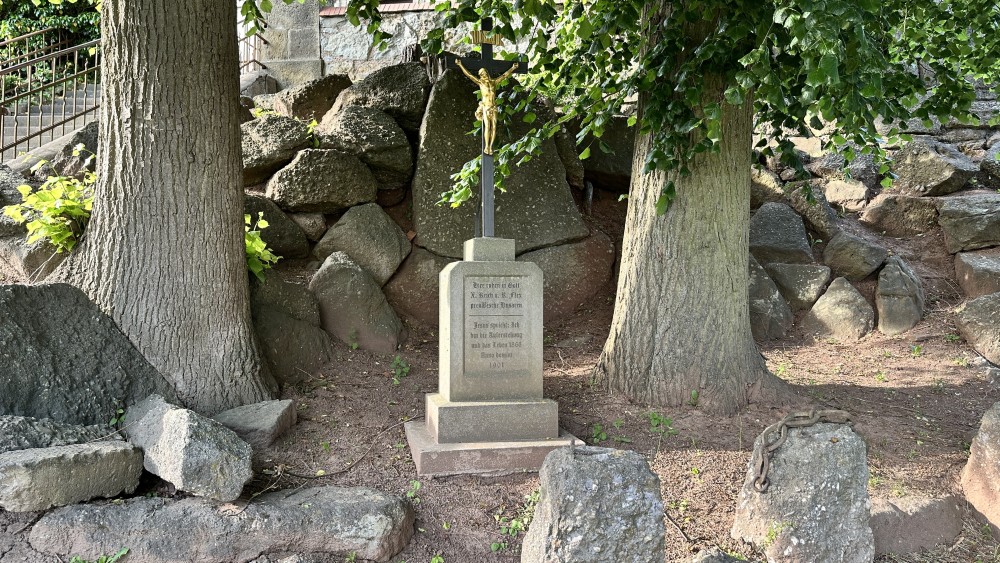
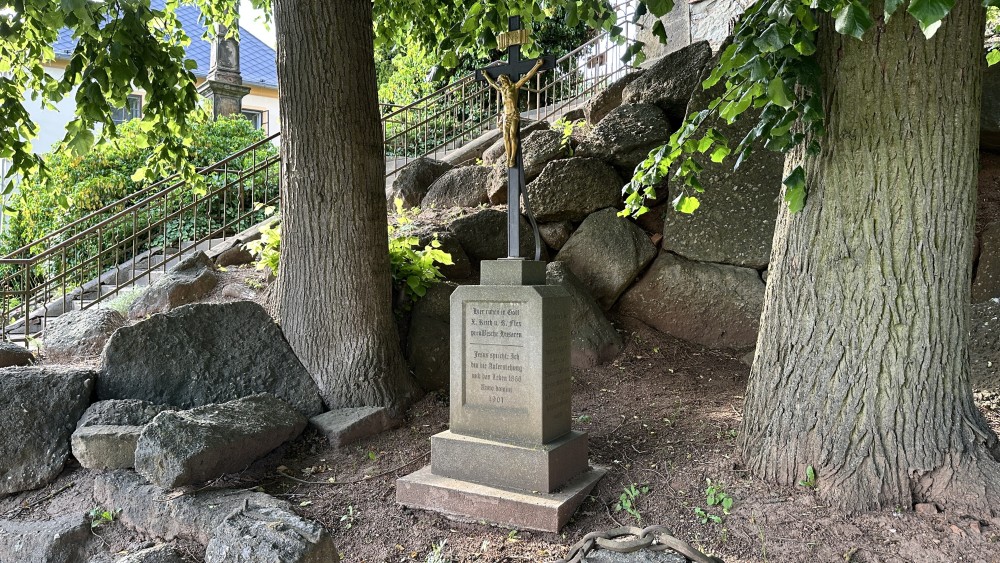
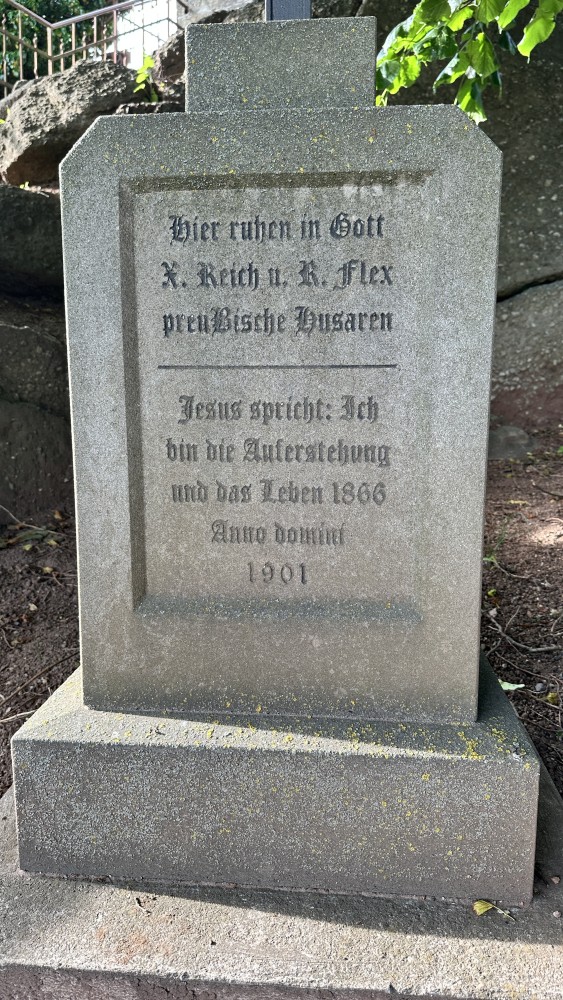
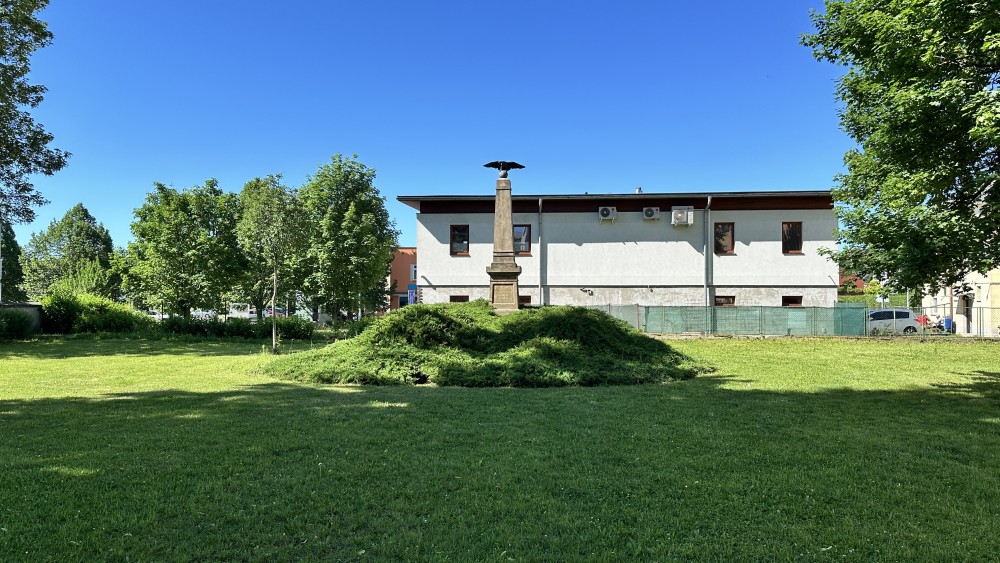
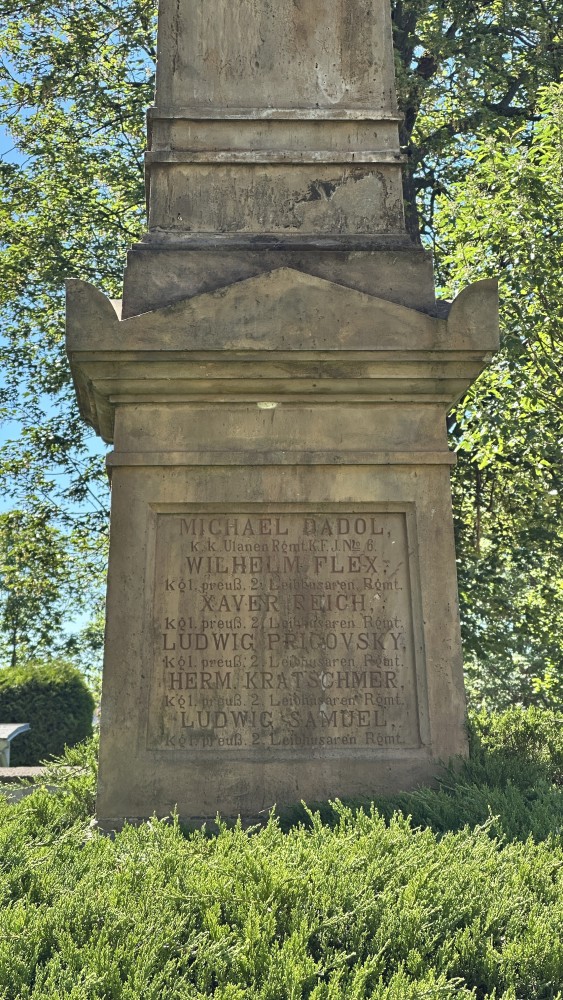
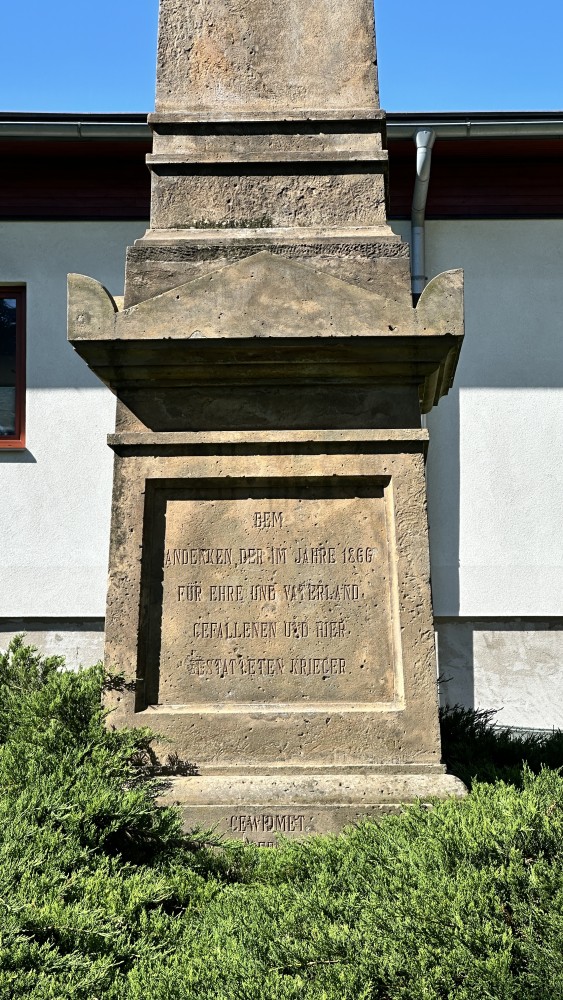
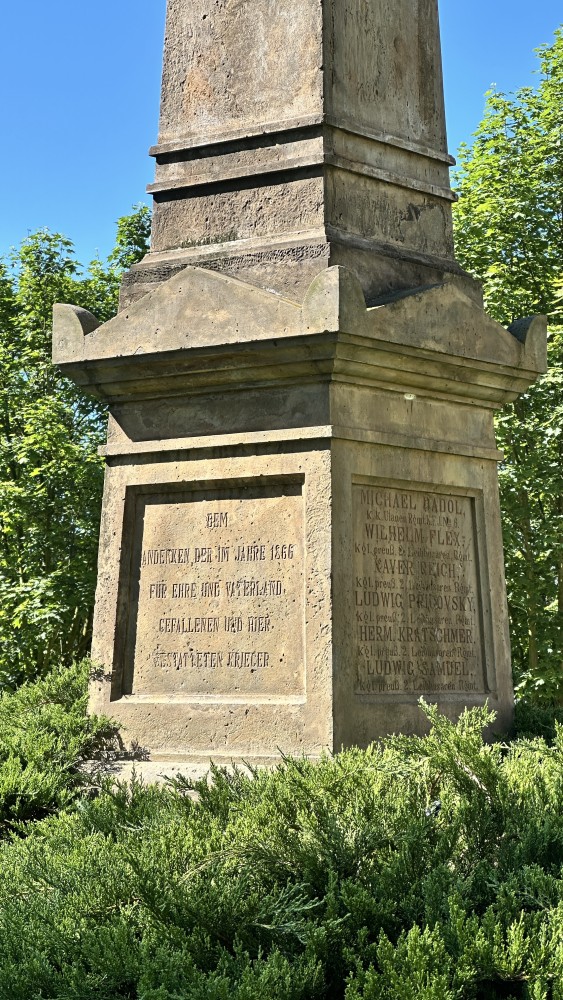
The cavalry skirmish at Rudoltice ended. But the war continued. Austrian troops were retreating towards Olomouc, and burials began on the field of the dead in Rudoltice. Fortunately, there were no casualties on the Austrian side. According to contemporary reports, four artillerymen even received a monetary gift from Colonel Count Bellegarde. However, after the clash at Rudoltice, the Prussians recorded 16 dead men and 11 dead horses, and an unspecified number of wounded and captured. Of the five dead that the Prussians left on the battlefield, three were buried in Damníkov and two in Rudoltice. The decisive factor was on which cadastral territory they remained lying. A tombstone for the two Prussian hussars from the 2nd Regiment of Body Hussars, buried in Rudoltice, was commissioned by Mrs. Karolina Janischová, a midwife in Rudoltice no. 148. Although the remains of these dead were later exhumed and buried in a common grave at the Lanškroun cemetery, this stone tombstone remained on the Rudoltice field. Until 1938, it stood behind the Church of St. Peter and Paul and occupied a dignified place there as a reminder of the 1866 war. The simple sandstone monument bore the inscription: “Here in God rest H. Reich and R. Flex, Prussian hussars. Jesus said: I am the way, the truth, and the life.” This monument was later moved to an inconspicuous place in the area below the church in Rudoltice, which is dominated by a tall stone cross from 1704, beneath which a memorial with a bronze plaque to the victims of the Great War 1914-1918 was placed in 1937. At present, the original decorative iron cross is broken and the inscription on the sandstone is very difficult to read. For the 700th anniversary of the first mention of the village of Rudoltice, a new granite memorial plaque to the victims of both world wars was unveiled in 2004 and consecrated by the Bishop of Hradec Králové, Mons. Dominik Duka.
text: Vladimír Mucha, valka.cz (published with permission)
photo: Matěj Brýdl